
Bhutan is a small country that most would struggle to place on a map. Sandwiched between Tibet, India, Nepal and Bangladesh it is nestled in the Himalayas. With only 800,000 inhabitants, it is sparsely populated and growing at a very ponderous 2% per year.
Bhutan was named by the British, meaning ‘High Land’ (or locally as ‘Druk’, meaning dragon). It is an extremely traditional nation which is protected by both church and state to maintain its culture, religions and traditions. Only opening up to trade in the 1970’s, it has preserved a huge amount of its culture, in the face of increasing exposure to the wider world. While multi-ethnic, the primary religion is Buddhism, and the practises run very deeply in this peaceful land.
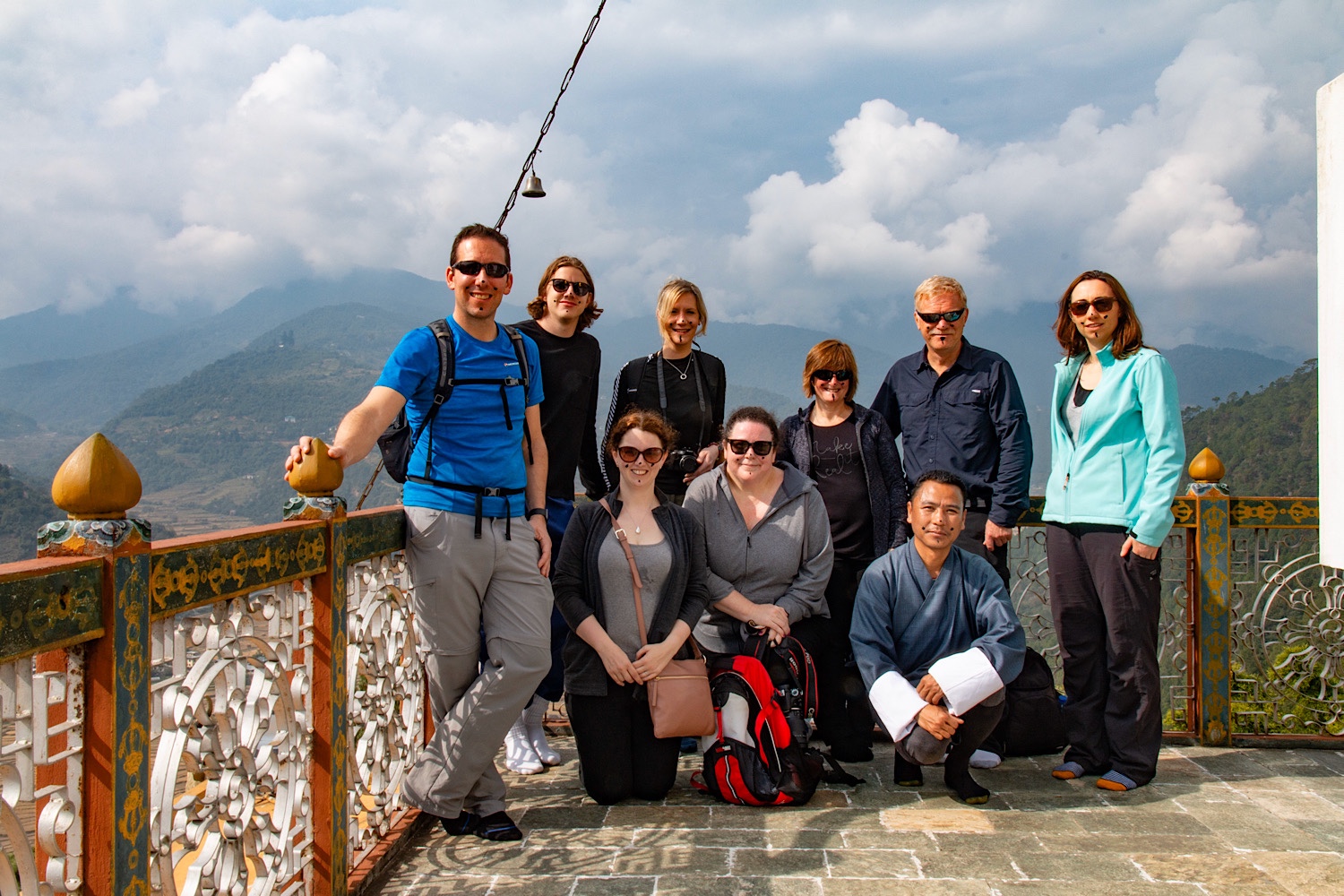
We met our group on the first evening. I’ve already introduced Jodie (from Warham); we also met Danielle & Conor (Auntie/friend and nephew/friend’s son from Australia), Fiona (from Dublin), and Barbara and Alan (from Canada but originally England). It’s a small, very well travelled group, with the exception of Conor, who is 18 and Bhutan is his first trip abroad… he’s gone deep! Our guide is ‘Hang’, a local Bhutanese guide, and our driver, ‘Captain’.
Day 1
On the first day, we took an acclimatisation hike up to the Cheri Dorji Dhen monastery. On the way to the base of the hike, we pass by thousands of coloured flags, strung between trees and over the road. Placed to catch the wind, these prayer flags line every roadside across the country, suspended by locals, each colour denoting a different prayer. These are complemented by white poles scattering the forests, prayer poles for the departed, trailing white flags in the winds.

We also pass tiny stupas, cone-shaped offerings placed in the cliff-side along the mountain roads. Hang informs us that these are made from the ashes of cremated relatives, and placed along the road as tribute to the deceased.
The Cheri Dorji Dhen monastery was built in 1620 by Shabdrung, the first ruler of Bhutan. It’s a reasonable walk up to the top, but we take it very slowly, marking the pace of the group as a whole, and minding the altitude. The monastery is at around 2800m. We’re allowed into the prayer hall, but like with all religious buildings in Bhutan, no photography is allowed, protecting the precious natural pigments of the intricately painted interiors from camera flashes of the eager tourists.
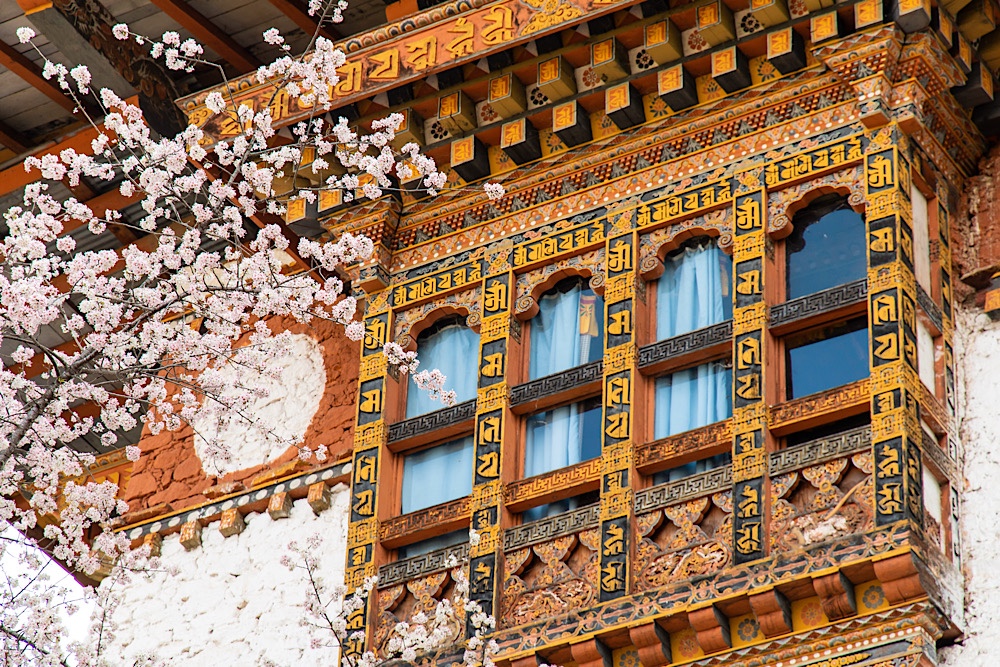
These buildings are beautiful, and this beauty isn’t the sole reserve of the Dzongs (fortresses), or monasteries. All Bhutanese buildings share the same roof design of crisscrossed wooden beams, hand-painted with the primary colours of Bhutan. It’s wonderful seeing such preservation of design in the face of rapid development.

We descend from the monastery, and travel back to Thimphu, where we visit a weaving centre and an incense factory. Unlike every other tour we’ve been on which has included a visit to local handicrafts, there was no expectation or pressure to purchase anything. In fact, the incense factory didn’t even have any for sale. This country really isn’t interested in attaining wealth; it belies the Buddhist belief system. We’re experiencing something very unique here.
Day 2
The next day, we take a drive to Punakha, the ancient winter capital of Bhutan. Before the 1960’s the population of Thimphu would migrate to the warmer, lower slopes of Punakha for the winter.
Enroute we visit Thimphu’s National Stupa, which has a train of worshipers continually taking a clockwise circuit around the striking building. After this, we take in the biggest sitting Buddha in the world, at 51.5m high, and costing $100m to build, it’s a pretty impressive sight.

Next we head to a local market, selling the 100% organic produce from local farmers; chillis feature heavily in the Bhutanese diet and we’re rewarded with dazzling displays.
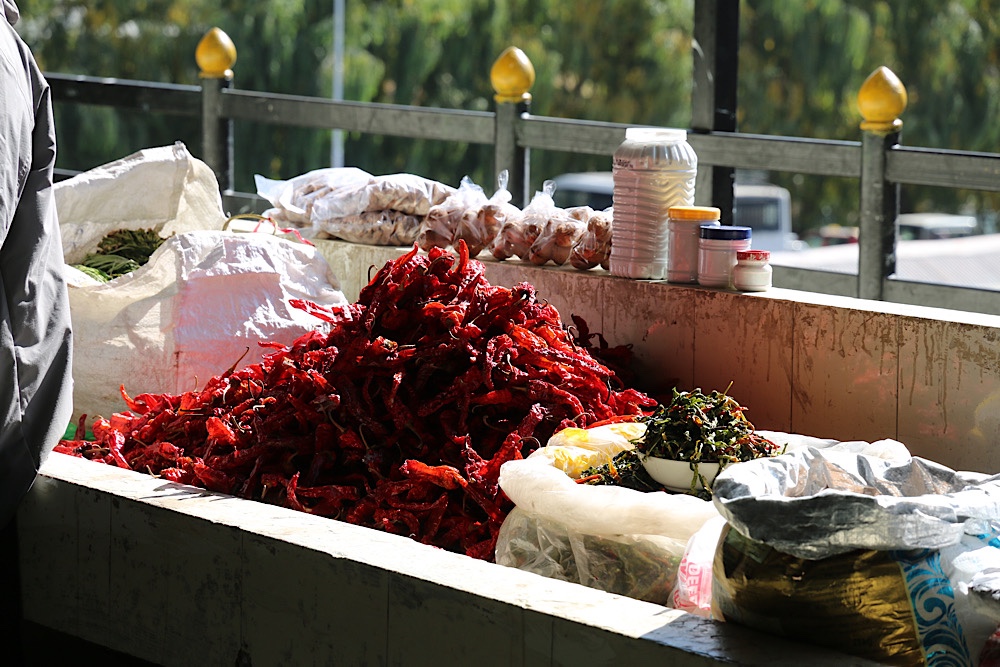

We have a local orange and throwing the remnants into a verge, Hang points at some plants growing next to the road. They’re Marajuana plants growing as weeds – apparently they grow naturally all over Bhutan.

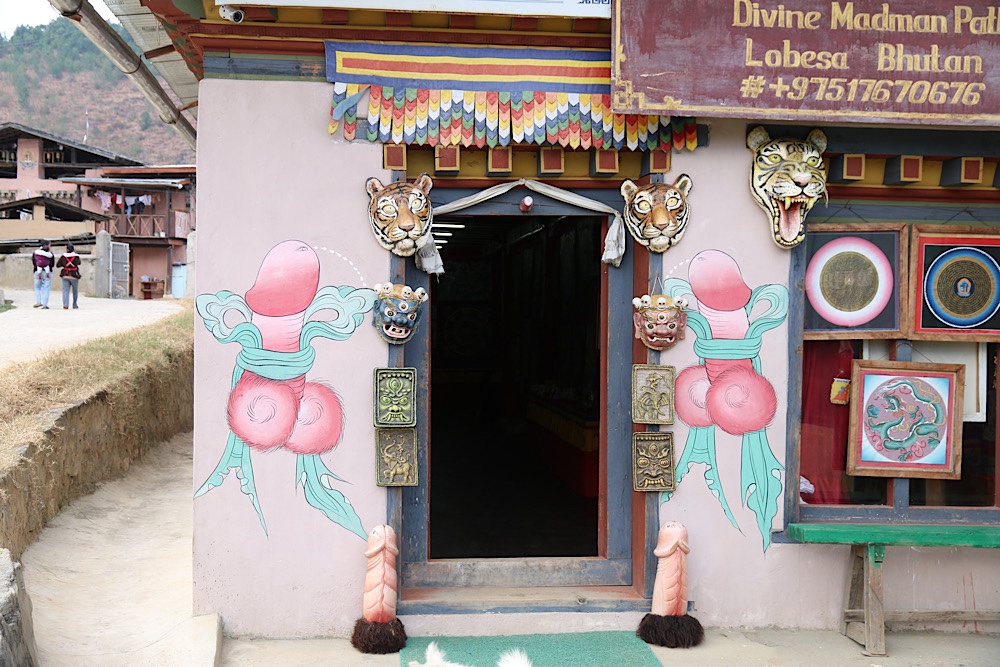
We stop for a walk through a small village and some paddy fields to visit Chimi Lhakhang, a fertility temple built in 1499 by lama Drukpa Kunley. There’s something rather odd about the village. See, Drukpa Kunley (also known as the Saint of 5000 women) had an interesting method of enlightening beings, usually women, by offering his blessing through sex. This earned his appendage the title of (I kid you not): “Thunderbolt of Flaming Wisdom”, which is a pretty decent name for the old chap.
Anyway, his temple is now visited by people from around the world as a fertility aid with, we’re told, a 90% success rate. The ritual involves the woman carrying a very large wooden carved phallus around the temple three times. All the women on our trip took a wide berth around the object.
The village, and Punakha in general wards off evil spirits by painting depictions of Drukpa Kunley’s Thunderbolt on the walls of their homes. As depictions go, they are pretty damned similar to the ones drawn at the back of school jotters by school boys. Obviously, being so mature and above such infantile humour, I couldn’t stop giggling.
We stayed overnight in Punakha, up a steep hill with a great view over the valley, and the Punakha Dzong. As we’d not done much exercise, I went for a run, from the hotel back down to the river and back up the 1/5 gradient hill… which went on for a kilometre. Had to pretend my legs weren’t sore for the next couple of days.
Day 3
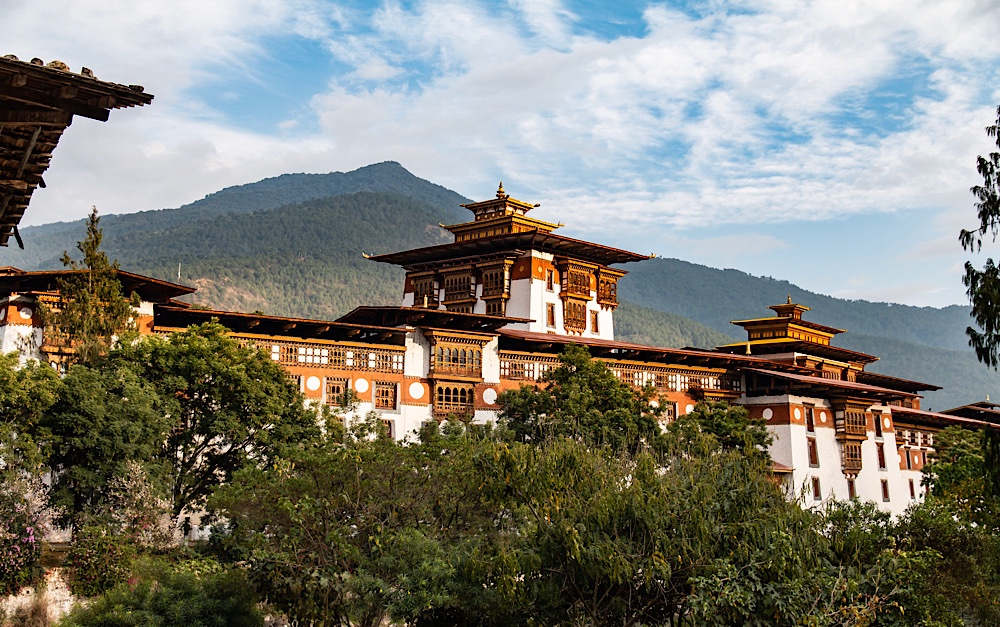
The next morning, we visited the Punakha Dzong, a beautiful fortress positioned between two rivers. We crossed a cantilevered bridge and paused under the grand entrance. Bees have made the ancient building their home, and huge honeycombs hang under the eves above the staircase. Fallen bees litter the ground.
After the fortress, we head along to the longest bridge in Bhutan. A 180m suspension footbridge. I ask Alan, who was a civil engineer, what his professional opinion was. “Hmm… Yes… Well” was all I got. We crossed over, and made it back, not without a significant amount of swaying and the odd bark of “can we keep moving?” from Ben whose vertigo and legendary patience was were both being strained.
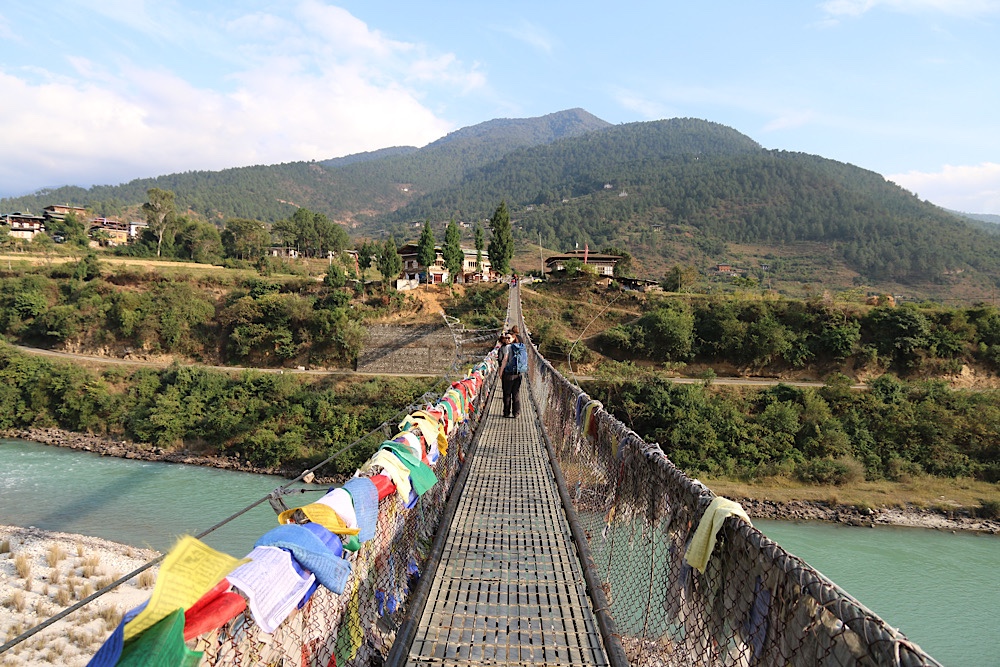
For our final stop of the day, we took a short hike up to the Khamsum Yulley Monastery, where a full service was underway, with the monks deep in chant as we entered the prayer hall. We ascending the stairs through the stupa and outside to take in a great view of the valley below.

Day 4
Today was a long day. We left Punakha on our way to Paro, stopping at Thimphu again on the drive back. We crossed back over a mountain pass and managed to snatch a glimpse of Gangkhar Puensum, both the highest mountain in Bhutan (7570m), and also the highest unclimbed mountain in the world.

We make several stops on the way back, including to one of the oldest residence in Bhutan (200yrs – they burn down a lot); play some archery, Bhutan’s national sport; try butter tea with rice crispies (tastes exactly like it sounds); visit a traditional craft training centre for young apprentices; visit another monastery; and take in dinner and a show that evening.
The show was traditional Bhutanese music and dance, which was interesting and at times funny, but the venue was a ropey restaurant, where we were served the same six-dish buffet that we’ve had twice a day for the past week… Tourism is still fairly embryonic here, and variety of choice hasn’t yet filtered through.
- Rice (white or red)
- Chicken (many bones, imported from India)
- Brocolli
- Cabbage
- Noodles (bland)
- Chilli Cheese & Veg (this is quite good!)
So far, Bhutan has been very beautiful, with very welcoming people and a relaxed, contented pace of life. We are being shepherded on a clearly standardised tour, seeing familiar tourist faces at the various temples and monasteries we’re visiting. The trip therefore feels quietly managed, and some parts of Bhutan are off-limits for us. I don’t mind this at all, as the Bhutanese desire to preserve their culture and heritage is the reason we can still experience this beauty.
Obviously a very religious place, the Bhutanese people have adopted and layered many superstitions, such as astrology, into their practiced Buddhism. Adding idols, icons, flags and phalluses, mantras, totems, rituals, and idiosyncratic practices, that somehow complement their systems of belief. It’s fascinating coming from such a simplistic monotheistic society, starting to scratch the surface of such a massively deep and complex theology.
 Travels with Sklaroffs