
We were up early again today, this time for a long drive to Abu Simbel. We had tried to get flights from Aswan but there was no availability so we checked out of our hotel at 5am and travelled by bus to the UNESCO World Heritage site of Abu Simbel.
After leaving Aswan, and passing through one of many armed checkpoints, we entered the desert. Several hundred kilometres with only one stop en route. The government has been investing in reclaiming large tracts of desert, and encouraging people to move to new cities, hewn out of the sand. We passed by huge canals fed from the Nile, bringing water’s life blood to miles of fields with automated irrigation systems seeded with crops. Military personnel run these farms, and Ahmed advised that they supported the Egyptian people during the pandemic.
We also passed an enormous carved depression, a hundred meters wide and several meters deep, running for miles. It has been excavated as a sluice from the Nile to run flood waters safely off into the desert, protecting towns downstream. The more worrying reason is the large Gerd dam recently built in Ethiopia. It is a 145m high dam and at a mile across, stores vast quantities of water. Should it breach it would do so catastrophically, sending a tsunami of water that would devastate Nile regions of Sudan, before hitting Egypt.
We arrived at a busy car park and walked down a well made walkway to a very impressive reveal; vast statues of Rameses II (who we’ll see a lot more of) border the entrance to his large temple. It was an imposing sight but equally impressive (actually more impressive for me) was the fact that this entire temple complex had been moved several hundred meters inland and 60m+ higher up following the flooding of Lake Nasser.
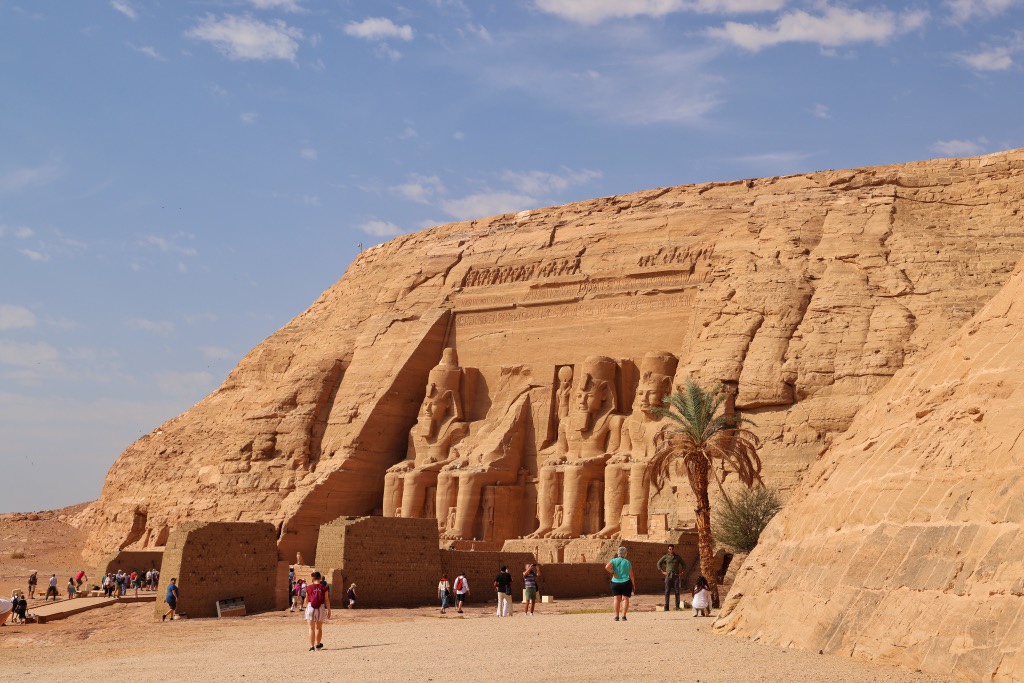

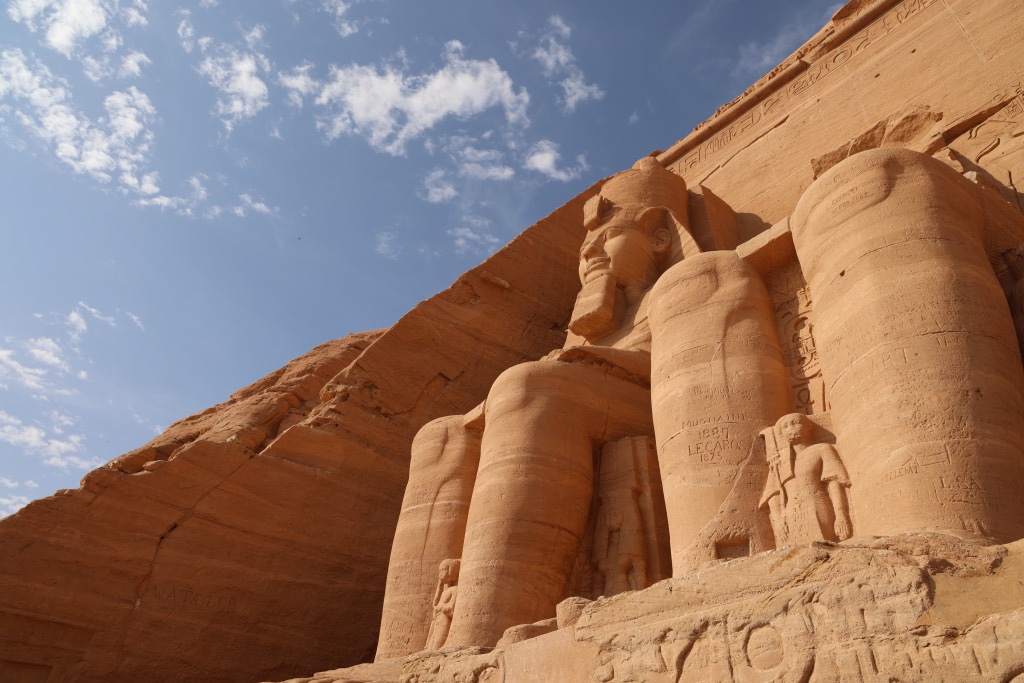
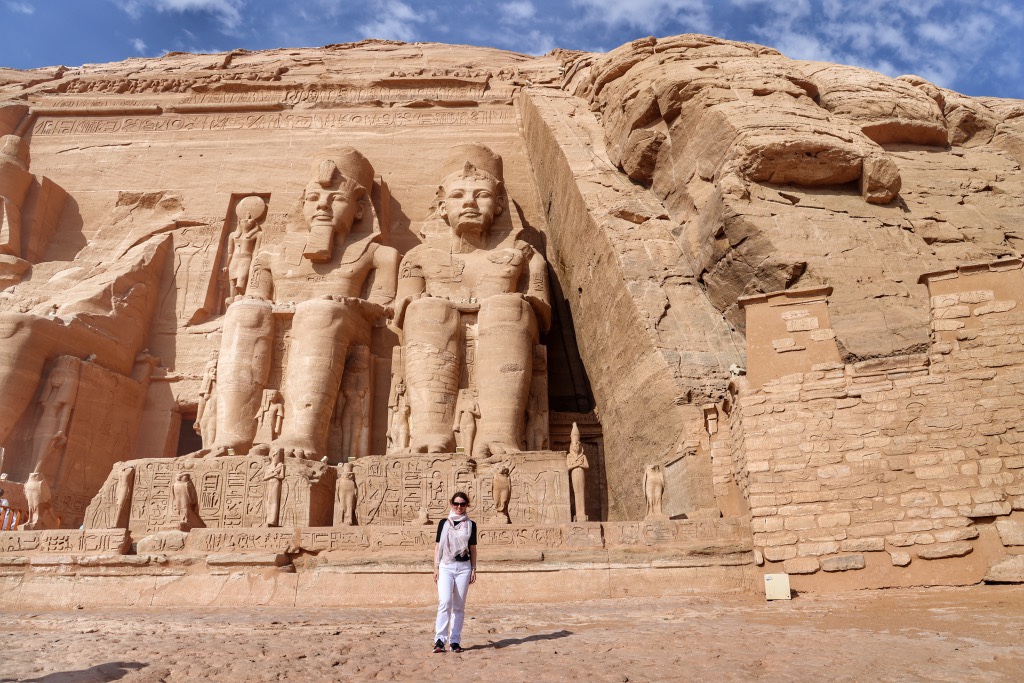
A UNESCO organised mission helped move this gargantuan ediface that was hewn from the cliffs, then reconstruct it in exacting precision, complete with an entire artificial hill surrounding the complex. The scale of the effort, and the result was staggering.
On the way back from Abu Simbel, we asked to detour to visit the Aswan High Dam – a place I felt I knew well, having been about the only thing I learned about in A-Level Geography. Unfortunately, it was a bit of a disappointment. Anticipating a vast concrete abutment dropping down to a river far below, it was more of a large embankment, albeit holding back a devastating amount of water in lake Nasser. Clearly my school studies didn’t extend to actually looking at a photograph.
After the brief detour, we checked into our accommodation for the next three nights, the Al Fayan II Nile Cruise board. Pleasantly surprised by the size of our cabins, our enthusiasm soon waned, when we discovered that Egypt also has cowboy builders. The showers on half of the boat flooded, where the refit in dry dock clearly hadn’t levelled the boat properly, so when the shower cubicle tiles were fitted, they weren’t angled to drain the water, and just flooded the bathrooms instead. The mirror fell off the wall (it had been attached with what we both agreed was actual bluetac). We couldn’t adjust the aircon and within a day, I had gastric issues from the food.
Nonetheless, we went for a lovely sunset sail in a Nubian Felucca sail boat, and a tour through the local market that evening. I slightly upset Ahmed when I refused a visit to a ‘local spice emporium’ (read: a place he gets a kickback from taking us into – to listen to someone tell us about how they gather their spices, then get the hard sell). But aside from this, it was a great day.


 Travels with Sklaroffs